


- Annual NFPA 80 fire door inspections help protect lives and are commonly required by authorities having jurisdiction (AHJs).
- Use a methodical 13-point checklist for swinging doors; other door types have their own checklists in NFPA 80.
- Common fail points in Chicagoland buildings include excessive clearances, label issues, improper hardware, and damaged seals.
Of course, it is of the utmost importance that your fire doors are up to code. The good news is that it is possible to pass an inspection on the first visit with minimal stress, if you approach the situation methodically, and especially if you call us in to help.
What are Fire Doors?
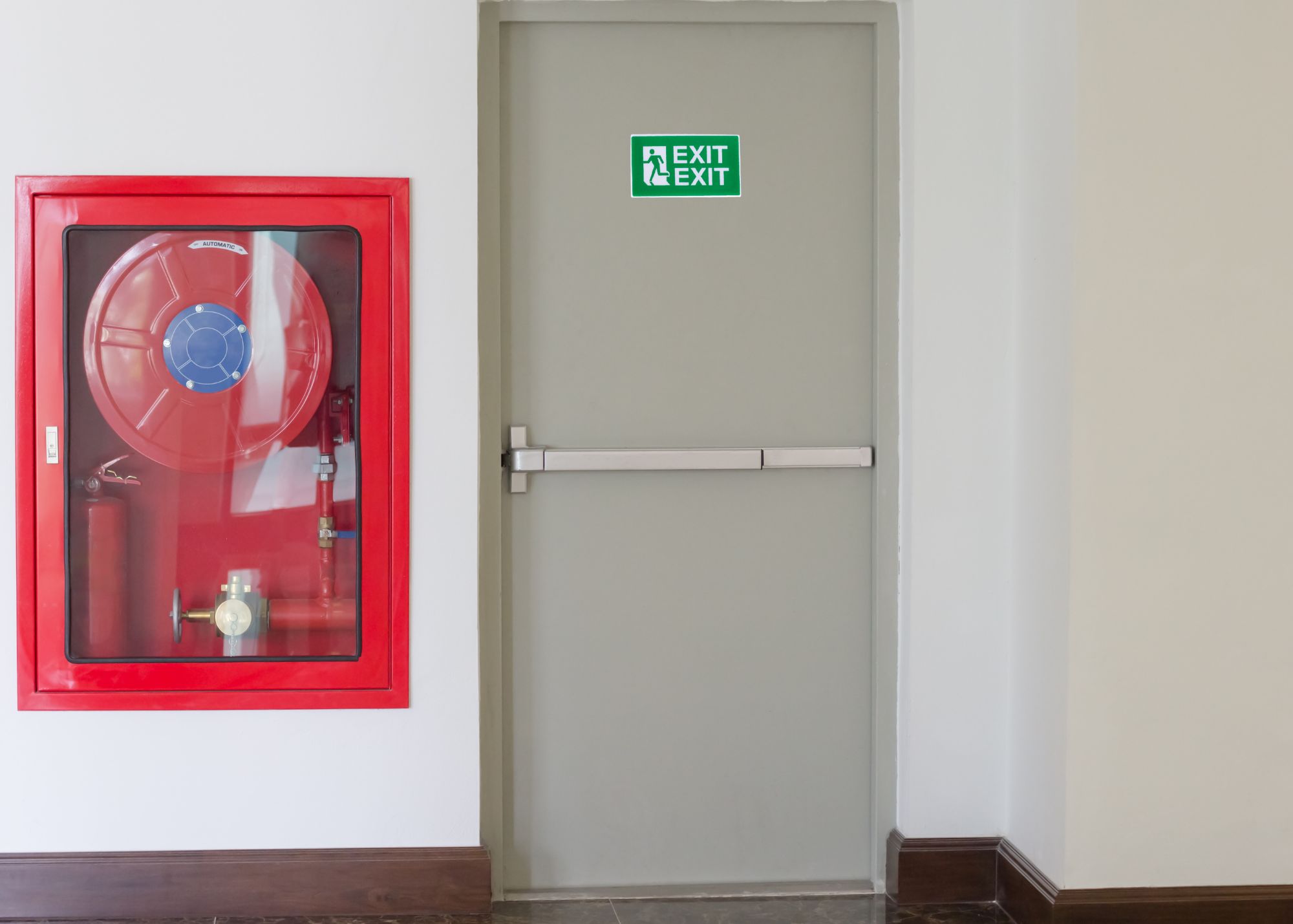
A fire door, as the name suggests, provides protection in case of a fire; they are considered part of your building’s passive fire protection system (“passive” because they only contain fires. Active measures include fire alarms and sprinkler systems). Fire doors are built of sturdy materials and hardware and are lined with seals and gaskets to help seal off a room. Ratings range from 20 to 180 minutes, meaning the door can hold fire and sometimes smoke at bay for at least that length of time.
Understanding NFPA 80 Fire Door Standards
The National Fire Protection Association issues the NFPA 80 Standard for Fire Door and Other Opening Protectives, which sets standards for doors designed to seal off a space and resist fire for a specified time. The standards are widely adopted by state and municipal governing bodies such as the City of Chicago or the Illinois State Office of the Fire Marshall.
NFPA 80 dovetails with NFPA 101, the life safety codes and functions like a subsection. The life safety codes are more comprehensive and have more to say about means of egress and accessibility. The fire door codes are specifically concerned with how a door and its hardware perform in a fire.
In short, to satisfy NFPA 101 life safety standards, all your fire doors will first have to satisfy NFPA 80 fire door standards.
Note that for doors that need to be rated for smoke leakage, you should refer to NFPA 105 Standard for Smoke Door Assemblies and Other Opening Protectives.
Designate or Hire an Expert
Your first priority should be to identify someone on your team who will be your fire door expert or else to hire a consultant who can help.
The Illinois State Office of the Fire Marshall does not have a specific requirement about who conducts fire door inspections. It only requires that that person understands the codes, that you conduct annual inspections, and that someone document and sign the inspection report.
As a security and safety partner, we at Anderson Lock have three certified fire door inspectors on staff who can help you conduct an inspection and identify any repairs or replacements that will keep you up to code.
Whether you work with us or someone else, you should still have an on-site point of contact. This person should attempt to familiarize themselves with NFPA 80 well enough to know what questions to ask and whether their consultants are being thorough enough.
When Will the Fire Marshal Conduct an Inspection?
The Illinois Office of the State Fire Marshal may conduct an inspection if you have a state-licensed day care or group home or an educational facility. In Chicago, the city Fire Prevention Bureau conducts inspections of:
- Hospitals
- Hotels
- Correctional facilities
- Nursing homes
- Shelters
- Day cares
- Schools
- After-school programs
- New construction
- Building rehabilitation
Inspections typically occur annually, but some facilities will have monthly walkthroughs to check specific features.
Cover NFPA 80 Basics with This 13-Point Checklist
To conduct your own fire door inspection, you will need to check for visible wear or damage to key structural components and test the doors opening and closing mechanisms, including any electronic controls.
Chapter 5 of NFPA 80 covers inspections. For swinging doors — the most common type — you need to check for these 13 things:
- Any labels are clearly visible and clear enough to read
- There are no visible holes or breaks in the surface of the door, frame, or threshold
- Any vision lites or glazing features are intact and secure
- The door, frame, hinges, hardware, and threshold are all aligned and in working order
- There are no missing or broken parts
- Door clearances are not beyond the standards set in chapters 4 and 6, typically ¾ in. beneath the door and ⅛ in. between the door and the frame
- The self-closing device functions properly, specifically, that the door goes properly from fully open to fully closed
- The inactive leaf of any coordinator closes before the active leaf
- All latching hardware catches and secures the door when it is closed
- No other hardware is installed on the door or frame that interferes with its proper operation
- There are no “field modifications,” that is, changes you made after installation, that compromise its function (or, as NFPA 80 puts it, that “void the label”)
- Any required meeting edge protection, gaskets, or seals are in place and sound
- Any signage meets the requirements of chapter 4
Note that improper signage can cause problems with items 3, 10, 11, and 13 if you install it improperly or the signs are too large. Signs seem like trivial things, but when it comes to fire doors, it’s best to be careful.
Note, too, that other kinds of doors, like sliding or rolling steel doors, have their own inspection checklists. Consult Chapter 5 of NFPA 80 to double check those.
Know the Common Fail Points for Chicago Buildings
Older Chicagoland buildings, especially, run into certain common problems that compromise their fire door safety and can lead to failed inspections. These include:
- Excessive clearances Repeated use, settling frames, and age can lead to increased gaps around your doors.
- Improper hardware swaps Using non-listed or rated hardware with inadequate hardware, or improperly installing hardware, can void the door’s label and make it no longer up to code.
- Painting over labels Routine improvements like repainting doors and frames may have the unintended consequence of covering over labels, so make sure your painters take proper precautions.
- Damaged gasketing or seals In heavy traffic areas like stairwells and elevator lobbies, the seals on your fire door can wear down or even be ripped off.
- Failure to self-close and/or latch It’s important to test the self-closers on your doors and to make sure they latch properly.
- Your staff Unfortunately, the people on your team can be the source of a fire safety problem. Train your staff not to wedge open fire doors. It’s a surprisingly commonplace issue that prevents self-closers from working properly and can lead to the spread of smoke and fire. Watch for certification programs or fire safety workshops that you can send your team to.
Preparing for a Fire Marshal Inspection
If you’re getting ready for an official inspection from the fire marshal or a third party, take these steps to set yourself up for success.
- Take an inventory If you don’t already have an inventory, it’s time to make one. You should have a list of each fire door and its assemblies, including ratings, locations, hardware, etc. Record dates when different elements were installed.
- Conduct your own 13-point inspection Using the list above and your inventory, see if you can spot and correct any problems on your own.
- Organize your documents You’ll want to keep records of past inspections as well as work orders, product information, etc. Keep it organized in a place you can find it again.
- Train yourselves Train and retrain your staff to notice damage to fire doors and not to block them or the paths to them.
To learn even more about fire inspections, read our “What to Know” guide.
Trust Anderson Lock for to Pass Your Fire Door Inspection
Fire door compliance is important for the safety of your people and property, and with regular inspections and proper maintenance, you can stay current and stay safe. At Anderson Lock, our certified fire inspectors are here to help with personalized guidance and support. Contact us today to learn more.
Frequently Asked Questions
How often should fire doors be inspected?
At least annually under NFPA 80. Some facilities also perform monthly walkthroughs to verify key features like self-closing and latching, as noted by many AHJs.
Who is allowed to perform the inspection in Illinois or Chicago?
The Illinois State Office of the Fire Marshal does not prescribe a specific credential. The inspector must be knowledgeable about applicable codes, perform annual inspections, and document and sign the report. Many facilities hire certified fire door inspectors for thoroughness.
What’s the difference between NFPA 80 and NFPA 101?
NFPA 80 covers the construction, installation, and inspection of fire doors and other opening protectives. NFPA 101 (Life Safety Code) addresses broader life safety topics like means of egress and accessibility. Doors must meet NFPA 80 to comply with NFPA 101 requirements.
What are common reasons fire doors fail inspection?
Excessive clearances, painted-over or missing labels, incorrect or non-listed hardware, damaged or missing gasketing/seals, and doors that don’t self-close or latch properly are frequent issues.
Do sliding or rolling steel doors use the same checklist?
They’re covered in NFPA 80 but have different inspection points. Review Chapter 5 for the correct checklist, and use NFPA 105 when smoke-leakage ratings are required.
What documentation should I keep for the fire marshal?
Maintain an inventory of all rated openings (with ratings, locations, hardware), prior inspection reports, work orders, and product data. Organize records so they’re readily available during inspections.