


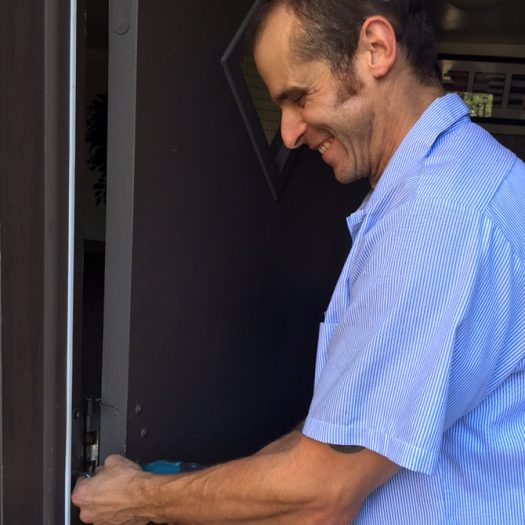
You’ve adjusted the hinges, twice. You replaced the bolt. Then the strike.
But the darn door still won’t close right. And you’re due for a fire inspection soon.
When a door won’t close or latch right in your commercial facility, especially after several repair attempts, there’s a good chance the problem is with the door frame.
Commercial door frames can get twisted, “cross-legged,” or out of plumb, causing your door to sag, scrape, stick, or eerily swing open at random times. Repairs to the door itself will only be band-aids that don’t address the real problem, which could lead to security vulnerabilities, failed inspections, exposure to liability, and higher energy costs.
Stop throwing good money after bad and learn the signs of door frame problems so you can apply the right solutions.
5 Common Signs Your Frame is the Problem
In commercial settings, heavy use can be enough to cause door frame problems, but they can also be signs that other things are going on with your building. It may be settling unevenly so that the walls are subtly warping, or there may be a leak allowing water damage.
Uneven gaps
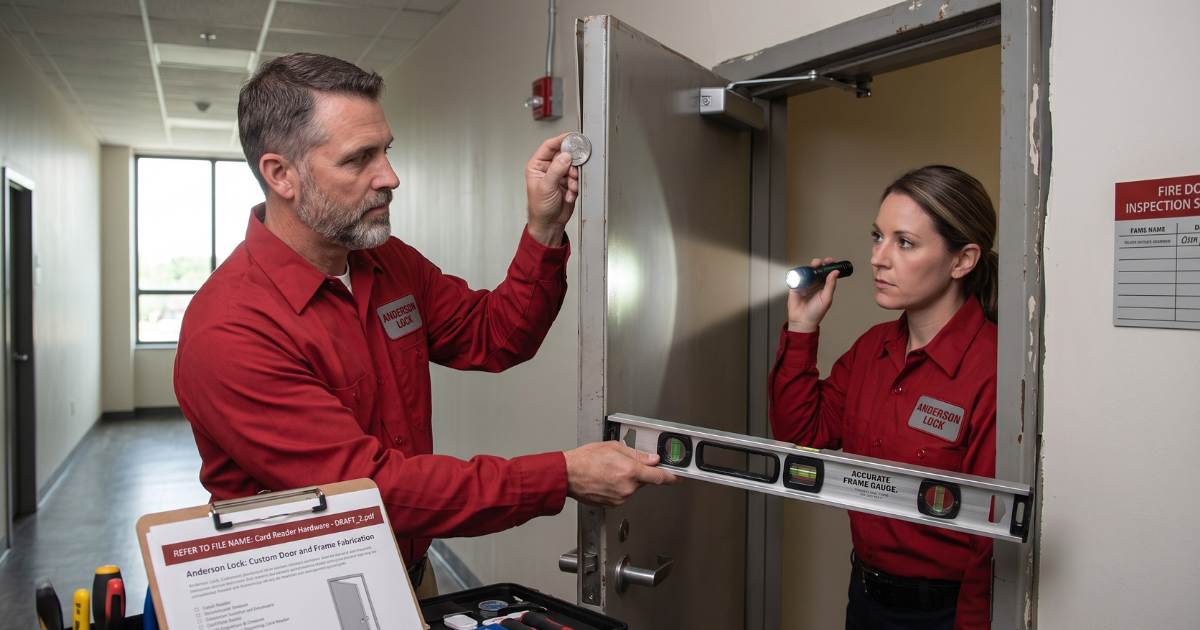
Take a thin ruler or a nickel and run it around the perimeter of the closed door. If it gets stuck anywhere, you’ve got a gap problem.
Light or air leaks
Turn on a light on one side of the door and turn off the lights on the other. Stand on the dark side and look for any light coming through. Feel around the perimeter of the door with your hand for any changes in air temperature; you can even run a fan on one side. Light or air means the door is sitting unevenly in the frame.
Sticking or scraping
Sticking at the top usually means the header (the top of the frame) is no longer level or the frame is out of square. Scraping at the bottom may indicate the jambs are cross-legged or out of plumb or that the floor has settled unevenly.
Door won’t latch
This is an obvious issue and often the point at which you call your locksmith. It’s caused by the frame shifting such that the strike plate and latch no longer align properly.
Ghosting
A door that randomly swings open (usually with a slow, creepy squeak) is not hanging square in its frame, which may indicate the frame itself has twisted in some way.
Note that if you have several of these symptoms, plus rust or water damage, it may indicate a problem with the foundation.
Still repairing the door without solving the problem?
Have an Anderson Lock door expert inspect the entire opening, including the door, frame, hinges, closer, latch, and surrounding conditions.
Why Commercial Door Frames Fail
- Structural settling
We’ve already seen this is a common issue, easily the most common. Buildings shift over time, and Chicago has a lot of older buildings that have been around for a while. It doesn’t take much to affect a wall or door jamb so that a door scrapes, sticks, or won’t latch.
- Door closer tension
An overtightened closer can pull against the frame and twist it over time. This can happen if it was installed improperly or if someone adjusted it incorrectly later.
- Chicago weather
We may not have the most extreme weather, but we do get weather conditions intense enough to affect your door frames. High heat can cause metal to expand, while humidity can swell wood. Freeze and thawing cycles, especially when they’re quick, can wrest frames out of alignment, or even crack them if there’s a water leak. Road salt tracked in during the winter can cause corrosion.
- Improper installation
This often happens when an older building has been remodelled several times, especially if someone was trying to trim costs. Frames need to be shimmed and anchored properly to any masonry. They need to be leveled and squared. Get this wrong at the start of the door’s life and you’ve already guaranteed yourself problems.
Ignore Frame Problems at Your Peril
At the risk of sounding dramatic, ignoring a frame problem with your commercial door may be inviting serious and costly consequences down the road.
A door that sticks may not always close and latch properly, and any door that doesn’t latch is an insecure door.
Those little gaps can mean big increases in your energy costs as heated or cooled air escapes your building.
Fire-rated door assemblies have strict requirements for the condition and operation of all the parts. If a frame is damaged or warped or the door won’t close properly, it voids the whole fire rating, and you’re not going to pass your inspection.
As we’ve said above, frame damage caused by settling can be a sign of damage to your foundation. Definitely something to catch before it gets worse.
Fire-rated doors create protective barriers to buy first responders more time to access anyone stuck in the building. Properly swinging doors are essential for safe and rapid egress in case of emergency evacuation. If you manage a hospital, school, or residential facility, you want to make sure you take all proper measures to protect your vulnerable populations.
Fix, Retrofit, or Replace?
A cross-legged frame doesn’t necessarily need replacing. Often, some judicious tinkering and adjusting can set things right. In other cases, a hardware retrofit may be possible.
Typically, we don’t opt for total door frame replacement unless the frame cannot be plumbed or squared or if doing so would void the fire rating.
It’s worth having an expert inspect your door and frame in order to determine the best solution, and to fix the problem the right way the first time.
In-House Fabrication: The Fix for Nonstandard Chicago Doors
Chicago has many old buildings with non-standard door frames, meaning factory-direct products designed for standardized modern construction just aren’t going to cut it.
That’s why Anderson Lock has its own door division. We’re capable of custom door and door frame fabrication to suit any Chicagoland retrofit.
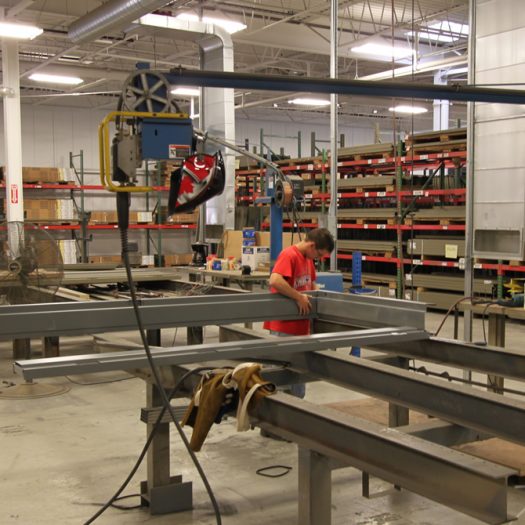
We are also a Warnock Hersey-authorized fire-rated shop. We can modify and recertify fire-rated doors and frames, keeping you compliant and saving you money.
A Door is Only as Good as Its Frame
Commercial door frames are not the most exciting topic and can easily feel like an inconvenient afterthought, but the reality is that the door and frame work together to keep your people and property safe and secure. A problem with your frame can become a financial headache as well as a life-safety liability.
You can trust Anderson Lock, a WBENC-certified woman-owned business, to accurately assess your door frames and work with you to find the best solution for your facility.
Contact us to speak with a door expert about that sticky or gappy door today.
Solve the whole opening, not just the symptom.
Talk with Anderson Lock about commercial door and frame assessment, repair, retrofit, fabrication, replacement, and fire-rated opening requirements.