



Making Life-Safety Hardware Choices for Chicago Buildings
Choosing the right electronic locking system for your building, whether commercial, residential, medical, government, educational — requires navigating regulations for securing your building against external intruders as well as making sure people can easily get out in an emergency. In Chicagoland, it can also mean dealing with historic structures not designed with modern access controls in mind.
When it comes to choosing between electric strikes versus maglocks, all these considerations are important, but typically, we begin with the most important: life-safety matters. Specifically, that means fire codes and free egress.
Let’s look at the pros and cons of electric strikes and maglocks with respect to your life-safety responsibilities and liabilities. We’ll also look at a related option: electric latches.
Understanding the Terminology of Strikes, Latches, and Locks
A couple terms before we get too deep into things.
The latch is the metal bolt that retracts to open the door and extends to secure the door in place.
The strike plate or strike is the metal plate in the door frame that the latch “strikes” as the door closes, causing it to retract until it can extend again into the hole in the frame.
On panic bars like you have in hospitals and schools, the latch may look like a little wedge that flips in and out of the bar rather than the slanted bolt that retracts on the door in your home. The strike on a panic bar is often a metal bar mounted on the frame rather than a plate mounted over a hole in the frame.
The hole in the frame is called a mortise, strike hole, latch hole, or even just “hole in the door frame” or “hole for the latch.” It’s a quirk of the profession that it does not have a more fixed term. For simplicity’s sake, we’ll just call it the latch hole here.
Access control describes any system for managing who can and cannot use a doorway, but usually we mean electronic access control where the user needs to use a fob, card, or PIN to unlock the door.
Electric strikes, electric latches, and maglocks are all hardware associated with electronic access controls, meaning, unsurprisingly, that they require power to operate. This will become important later.
One key takeaway to keep in mind is that latches are mounted on doors and strikes are mounted on door frames.
Fail Modes
Electric locks have two primary fail modes, which is to say, how the lock operates if it loses power.
Fail-Safe: Fail-safe systems require power to lock the door, so if they lose power, the door unlocks. They are safe because they ensure people can easily get out through the door. These are a good choice for many interior and high-traffic doors, or access doors for roofs, stairwells, and parking garages where you don’t want anyone to get stranded.
Fail-Secure: Fail-secure systems require power to unlock the door. If the power goes out, the door remains locked, or secure. These are pretty much industry standard for exterior doors because they keep your building secure in case of a blackout.
While a fail-secure lock will be locked from the ingress side during an emergency, both fail-safe and fail-secure locks can be operated manually from the egress side.
Life-Safety Codes
The State of Illinois abides by the 2021 International Building Code (IBC). The City of Chicago does, too, with a few amendments, but those don’t affect our discussion here of free egress.
Free egress just means that, in case of emergency, people inside the building have a free, unobstructed path to an exit, or the means of egress. There should always be a path to an exit through doors that can be opened manually.
A fire door is one that has to meet certain fire-resistance standards, must be self-closing and latching, and must allow for free egress. Many fire doors are in the means of egress, though some may be installed strategically to mitigate the spread of smoke and flames.
Electrically locked doors in the means of egress must unlock when a sprinkler system or smoke detection system goes off. They also must unlock when the power goes out.
Some of the language in the codes can be confusing despite attempts at being precise. Note that “unlocked” in this context means that you must be able to operate the latch manually from the egress side of the door, i.e., you need to be able to get out of the building. An exterior door, for instance, can still be locked from the outside.
Electric Strikes vs. Maglocks vs. Electric Latches: A Comparison
The Versatile Electric Strike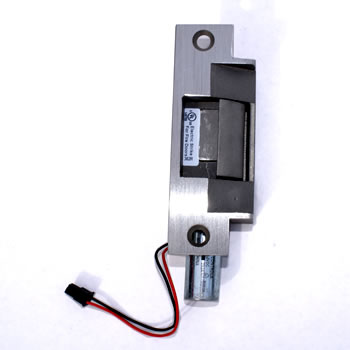
Electric strikes are among the most common form of electric lock hardware because they are the most cost effective and the easiest solution for retrofitting older buildings. Most of the time, if someone is “buzzing you in,” they’re activating an electric strike.
With an electric strike, a user presents a credential like a fob or card or hits an internal button, and a metal bar inside the latch hole, called a keeper, moves out of the way so the door can be opened. Because the action happens on the door frame side, you don’t have to turn a door knob or press a lever to retract the latch.
Electric strikes have few parts, work with many existing latches, and only draw power when someone hits the buzzer.
Electric strikes can be either fail-safe or fail-secure. Note that electric strikes on fire doors must be fail-safe, i.e., they must unlock so people can get out during a fire.
The Powerful Maglock
Electromagnetic locks, usually just called maglocks, use magnetic force to hold the door in place. This involves an electromagnet mounted on the door frame and an armature plate attached to the door. Running power to the electromagnet creates a powerful bond.
Maglocks only require about the same amount of power as a security camera, so they easily integrate into your current electric system. Because the magnet uses power, maglocks are always fail-safe. Once the power goes out, the magn
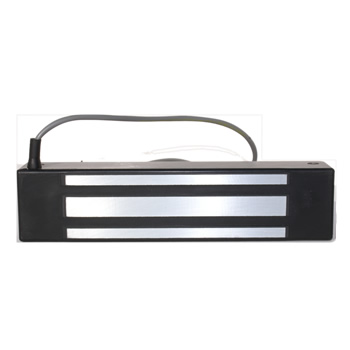 etic forcedissipates and the door will be open.
Maglocks are surprisingly powerful and are attractive options for many business interior doors, especially glass doors, because they do not require a lot of hardware around the door handle. They are also very durable because there are no moving parts and no parts that strike each other over and over.
As cool as maglocks are, they have some disadvantages. They must be installed and aligned carefully to work properly. If installed improperly, or if the materials degrade over time, the lock can become “sticky,” meaning there is residual power in the magnet that makes you have to pull harder to open the door. Some property managers also don’t like the idea that the lock requires constant power.
Maglocks and Life-Safety/Free Egress
All maglock doors must unlock in an emergency, meaning they are only fail-safe. This makes maglocks less useful on exterior doors.You also need one or two other devices for maglock doors to meet life-safety codes. First, you must have a button on the wall labeled “Push to Exit” that allows someone to manually unlock the doors. (Any electric lock needs this button if there is no other hardware on the door to manually open it.)For doors requiring free egress, you need to get an additional device called a REX, which means request to exit. A REX is an infrared sensor connected to the maglock on the inside of the door that disables the magnet whenever someone approaches the door.
The Maximalist Electric Latch
The electric latch gives you the most security with the most options. These systems are mounted in the door and work by retracting the latch.
Because they operate the locking mechanism itself, they provide more reliable and flexible security. There are many varieties of electric latch, including mortise locks, deadbolts, and even maglocks.
Electric latches can be either fail-safe or fail-secure, offering an additional level of choice.
Quick Comparison of Electric Strikes vs Maglocks vs Electric Latches
We can sum up the differences among electric strikes, electric latches, and maglocks like so:
Advantages
Disadvantages
Electric strike
Cost-effective
Easy to retrofit/works with existing latches
Fewest parts
Fail-safe or fail-secure
Only draw power when triggered
Less secure than electric locks
Less ideal for high-security areas (vaults, server rooms)
Maglock
Powerful
Attractive/minimalist
Durable
Low-maintenance
Easy to retrofit and install
Require constant power
Require additional device
Expensive hardware
Only fail-safe
Electric latch
Most secure
Most hardware choices
Fail-safe or fail-secure
More complex installation
Can be pricey
Require some constant power
Trust a Family Business for Life-Safety Choices
When you’re facing the choice of electric strikes vs. maglocks vs. electric latches — and the safety of your tenants is at stake — it never hurts to ask an expert. Anderson Lock has been a family-owned business since our founding over 60 years ago, and we take life-safety very seriously.
If you’re planning a big upgrade for your Chicago-area building or buildings, contact us today for expert advice in making the best choice for your property.
Frequently Asked Questions
What is the difference between panic hardware and fire-rated exit hardware?
While both allow for quick egress, fire-rated exit hardware is specifically designed to withstand intense heat and ensure the door remains latched to contain fire, whereas standard panic hardware may include ‘dogging’ features that are prohibited on fire doors.
How do I choose between a fail-safe and fail-secure electric strike?
At Anderson Lock, we recommend fail-secure strikes for exterior doors to maintain security during power outages. Fail-safe strikes are better suited for interior doors, such as stairwells, where occupants must not be trapped during an emergency.
Are maglocks legal for use on Chicago commercial exit doors?
Yes, but they must comply with IBC life-safety codes. This requires the maglock to be integrated with the fire alarm system and usually necessitates a ‘Push to Exit’ button and a Request-to-Exit (REX) sensor to ensure free egress.
Why is my panic bar sticking or failing to latch?
Common causes include misalignment, worn internal components, or ‘sticky’ residual magnetism in electrified systems. Anderson Lock provides expert troubleshooting to identify if you need a simple adjustment or a full hardware replacement.