


The best time to upgrade to electronic access controls was twenty years ago. The second best time is now. Chicagoland is a dense urban and suburban region, and your building sees constant traffic from customers, residents, and even passers-by. Legacy mechanical locks offered ingenuity and even beauty for decades, but nowadays, both commercial and residential customers expect electronic access controls.
The decision facing you as a building owner or manager is not whether you need electronic access controls but whether you need wired or wireless access controls.
No two buildings are quite alike, and your priorities may be different from your neighbor’s. At Anderson Lock, we believe the right choice between wired and wireless controls is the one that serves you best.
But this isn’t just another “it depends” or “it’s up to you” article. There are specific conditions when choosing wired or wireless makes more sense. As your lock and door security partner, we can help steer you to the best solution.
The tl;dr version is that most buildings should choose a mix of wired at points of entry and wireless on interior doors.
The longer version is that we can collaborate with you to create custom access control systems based on factors like architecture, tenant needs, technology preferences, and budget.
Access Control Basics
The differences between wired and wireless access controls will be largely invisible to most users. Both can work with most kinds of what people think of as electronic entry controls: key fob, keycard, number pad, biometric scanner (fingerprint, retina, face), even mobile phone.
In addition, both formats offer comparable cybersecurity features with respect to issuing credentials and record keeping. Either can be connected to an onsite server or to a cloud-based service, and they can typically be mixed and matched on the same network and operated from the same dashboard.
Finally, either can be installed in compliance with local fire and life safety codes like NFPA 80 and NFPA 101.
Wired Access Control: Mission-Critical Reliability
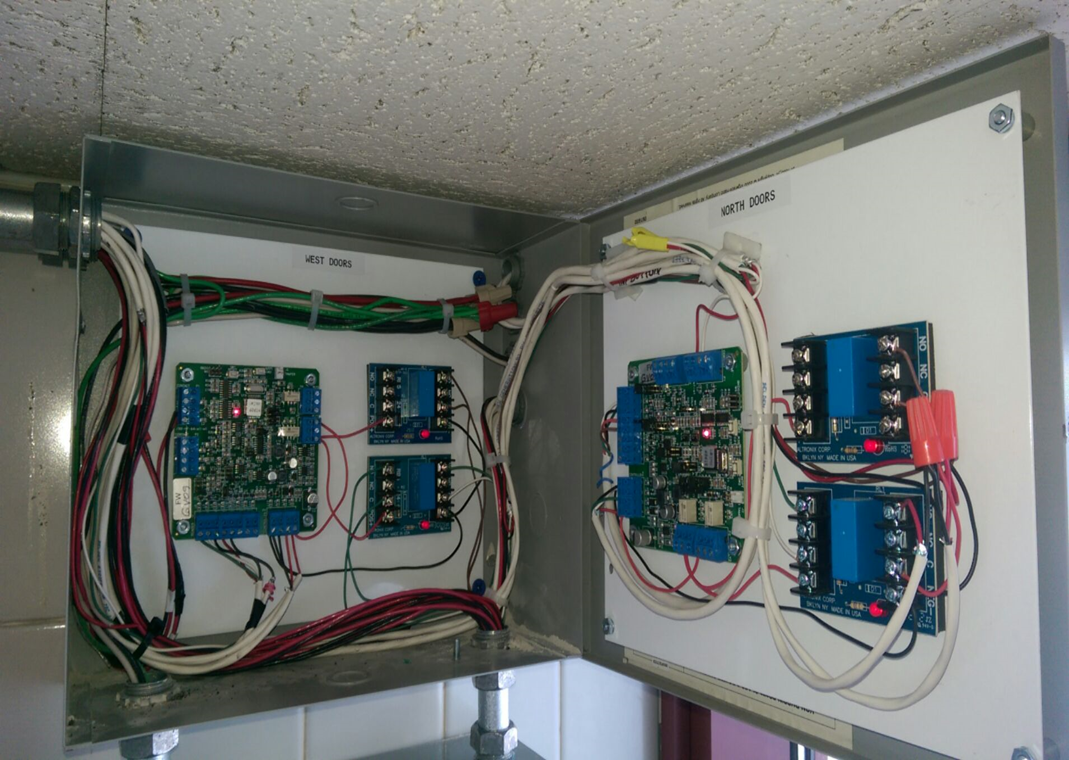
Wired access controls use ethernet or dedicated cables (often power-over-ethernet, or PoE) for power and connectivity.
Their primary advantage owes, of course, to that permanent wiring. They are not vulnerable to Wi-Fi outages or signal disruptions, and they can be connected to your building’s backup power to continue working during an electrical outage.
Pros & Cons of Wired Systems
Their primary disadvantage also owes to the permanent wiring. Most older buildings in Chicagoland were not built with electronic access controls in mind. While modern innovations certainly make it easier than ever to retrofit an historic building with modern access controls, it can be a costly and disruptive process. It’s also very important that the installer knows what they’re doing, as poor routing or inferior cables can create issues and incur expenses further down the road.
Thus, wired access controls are easiest to adopt in new construction or during extensive renovations. Basically, if you’re running wiring anyway, it’s a smaller lift.
We also recommend wired access controls for your primary entrances and doors to mission-critical spaces like server rooms — anywhere that stability and integration with the building’s power are top priorities.
Wireless Access Control: Maximum Adaptability
Because they are not connected to a power source, wireless systems rely on battery power and wireless network connectivity. They may use Wi-Fi, Bluetooth, Zigbee, or a proprietary radio frequency (RF).
Pros & Cons of Wireless Systems
Wireless access controls offer maximum convenience for any building. Installation tends to have a minimal impact on your building, and they can more readily be installed in hard-to-reach spaces. This also makes them much more economical on the front end.
Being battery-powered means there’s no danger of access problems in a blackout, but of course, you’ll have to monitor and switch out the batteries on a regular basis. This means a small, ongoing, additional materials and labor cost over a wired system. You won’t experience any real operational disruption, however, because these devices are set up to chirp like a smoke alarm or blink before the batteries completely die. The fanciest ones can be monitored via software, and some building managers choose to replace all device batteries regularly, also like a smoke alarm.
Wireless systems have similar network vulnerabilities as your phone. Metal walls, various kinds of interference, or cloud disruptions can impact their operation. A wireless control may not be right for some locations in your facility.
Note that these network limitations will be the same for cloud-based wired controls.
We often recommend wireless controls for retrofits, building interiors, and historic Chicago buildings where architectural impact is a concern.
Side-by-Side Comparison
| Wired | Wireless | |
| Up-front cost | Higher due to labor and materials | Lower |
| Installation time | Longer, requires changes to infrastructure | Shorter — In-place and retrofit friendly |
| Scalability | Technical, requires cables and electrical wiring | Simple, only requires network connection |
| Reliability and convenience | Consistent, less vulnerable to network and power disruptions | Periodic, requires battery maintenance |
| Ideal use | New construction, perimeters, mission-critical spaces | Historic buildings/retrofits, interior spaces |
Adapting to Chicago’s Historic Architecture
Historic buildings like the Post Office or Federal Reserve Bank can present installation challenges when there are mandates about preservation of architectural features. It is not always convenient or feasible to drill into marble, stone, or thick masonry to run wires. Thus, as we’ve said, many managers of buildings with historical significance will opt for wireless controls.
At the same time, the materials in these buildings can create issues for any device connecting wirelessly to your network, regardless of its power source. Thus, you may need to work with your installers and IT people to set up a mesh network or network repeaters.
Installing wired systems in these buildings tends to make the most sense when you are making significant renovations to interior spaces rather than trying to install them on the building’s enclosure or outer walls.
The Reality: Taking a Hybrid Approach
Most of our partners, whether commercial, residential, or governmental, wind up taking a hybrid approach. They use wired systems on exterior or perimeter doors where possible and choose the simpler, more cost-effective wireless systems for interior doors.
This mix optimizes for reliability, installation disruptions, and your budget. You get the set-and-forget reliability of wired controls where you need them most and the convenience and flexibility of wireless systems everywhere else.
Key Requirements for a Security Partner in Chicagoland
No electronic access control will feel right if it is installed and implemented poorly. At Anderson Lock, we’ve been serving businesses, schools, and local governments for over 65 years, and we’ve grown with the lock and security industry. We believe we offer the best hardware and door solutions and security expertise in the area, but whomever you choose to partner with, make sure they meet these minimum requirements:
- Solid local reputation
- Demonstrable success serving similar buildings
- Experience coordinating with project managers
- Personalized, customized service
- Technical expertise in setting up wired and wireless networks and implementing controller software
- Industry expertise in relevant fire, life safety, and building codes
- A commitment to customer satisfaction and service beyond the installation
Find the Right Mix of Access Controls for Your Chicagoland Office Building Today
We love helping the Chicago region’s office building managers design the right electronic access control system for their facility — we get to spend time getting to know you and your building and the specific challenges and problems it may present, and then we get to customize a solution to meet all your needs.
If you’re ready to learn more about wired and wireless access controls for your office building upgrade, contact us today to get connected with an access control expert.